

Sacroiliac Joint Dysfunction Relief: Targeted Gonstead Chiropractic Treatment in Ringwood
Sacroiliac Joint Dysfunction (SIJD) causes deep buttock pain. Learn the causes and how targeted Gonstead chiropractic care in Ringwood may assist in restoring stability.
1. Introduction
Musculoskeletal conditions, particularly chronic low back pain, represent a substantial health challenge and economic burden across Australia. Chronic back problems affect approximately 4.0 million Australians (16% of the population), contributing significantly to the nation’s disease burden.
Within this widespread issue, pain originating from the sacroiliac (SI) joints is often a significant yet overlooked cause. Sacroiliac Joint Dysfunction (SIJD) is a commonly identified source of mechanical low back pain, estimated to affect between 15% and 30% of patients presenting with discomfort in the lower back. When SIJD restricts movement and diminishes the ability to perform daily tasks, many Australians seek effective, evidence-based, conservative care.
Chiropractic professionals, especially those trained in precision techniques like the Gonstead Method, specialise in the assessment and management of spinal and pelvic mechanical issues. By focusing on identifying the underlying structural fault in the pelvis, Gonstead chiropractic care aims to assist patients in managing symptoms, restoring optimal movement, and developing a long-term self-management plan.
2. What is Sacroiliac Joint Dysfunction (SIJD)?
Sacroiliac joint dysfunction refers to a mechanical problem arising from the SI joint, the articulation between the sacrum (the triangular bone at the base of the spine) and the iliac bones (the large bones of the pelvis).
Anatomy and Biomechanics of the SI Joint
The SI joints are essential for distributing load throughout the body. They function as critical load-transferring structures, transmitting the substantial forces and weight generated by the upper body directly to the pelvis and lower extremities. They are heavily reinforced by some of the body’s strongest ligaments and act as important shock absorbers.
Due to this robust ligamentous structure, the SI joints possess a very limited physiological range of motion (ROM), typically only a few degrees of movement. SIJD occurs when this small, precise movement becomes abnormal, resulting in non-optimal load transfer. This abnormality is generally categorised into two mechanical extremes:
- Hypomobility (Fixation): Too little movement in the joint, often leading to stiffness and localised tension.
- Hypermobility (Instability): Too much movement or ligamentous laxity, which can cause instability and pain radiating into the hip or groin area.
Distinguishing SIJD from Sacroiliitis
It is crucial to differentiate SIJD, which is primarily a mechanical, non-inflammatory issue, from Sacroiliitis, which refers to specific inflammation within the joint. Sacroiliitis is often associated with systemic inflammatory conditions, most notably Ankylosing Spondylitis (AS) or psoriatic arthritis.
3. How Does the Condition Happen?
SIJD results from forces or changes that disrupt the intricate stability of the lumbopelvic region, leading to abnormal motion or strain on the joint capsule and surrounding ligaments.
Biomechanical Causes and Strain
The SI joint is stabilised both by its inherent structure and the dynamic compression provided by muscles. Dysfunction arises when these stabilising elements are overwhelmed:
- Trauma: A direct, sudden, high-impact force, such as falling directly onto the buttock, can immediately strain the SI joint ligaments.
- Repetitive Stress and Loading: Activities that place persistent, asymmetrical loading or rotational shear forces on the pelvis can lead to microtrauma and subsequent dysfunction. This includes repetitive movements common in certain occupations or high-impact activities like running and jumping.
- Muscular Deficiencies: The stability of the SI joint relies on the timely and efficient activation of deep stabilising muscles (e.g., Gluteus Maximus and Transversus Abdominis). If these muscles fail to activate correctly, the resulting non-optimal load transfer increases stress on the SI ligaments, potentially leading to instability or pain.
Screening for Inflammatory Factors
When pain is suspected to be mechanical SIJD, careful assessment is necessary to rule out inflammatory causes, which require a different management approach. Key distinctions between common mechanical back pain and inflammatory back pain are crucial for patient management :
|
Characteristic |
Typical Mechanical SIJD Pain |
Typical Inflammatory Back Pain (e.g., AS) |
|
Age of Onset |
Any age. |
Usually under 40 years old. |
|
Course of Symptoms |
Variable onset, often linked to activity or trauma. |
Insidious onset, lasting longer than three months. |
|
Response to Rest/Activity |
Improves with rest; worsens with prolonged sitting/standing. |
Improves with exercise; does not improve with rest; may wake patient at night. |
|
Morning Stiffness |
Mild, short-lived. |
Moderate, often persisting for over 45 minutes. |
Export to Sheets
If inflammatory symptoms are suspected (such as morning stiffness lasting over 45 minutes that improves with movement), the practitioner would recommend co-management with a General Practitioner or specialist to investigate potential inflammatory conditions.
4. Who Does It Happen To?
SIJD can affect a wide range of individuals, but certain demographic and physical factors increase susceptibility.
Typical Demographics and Risk Factors
The prevalence of back problems, including SIJD, is similar between males and females, but women are disproportionately affected by mechanical SIJD, partly because the female SI joint exhibits greater natural mobility than the male joint.
Specific groups face elevated risk:
- Peripartum Patients: SIJD is common during and after pregnancy. Hormonal changes, particularly the release of relaxin, temporarily increase ligamentous laxity in the pelvis, placing significant mechanical stress on the SI joints.
- Athletes and Active Individuals: Those participating in high-impact sports, running, or repetitive rotational movements place undue shear forces on the SI joints.
- General Lifestyle and Occupational Risk Factors: Risk factors for low back pain generally include advanced age, being overweight or obese, smoking, and occupations involving heavy physical loading, repetitive lifting, or prolonged static postures (such as long periods of sitting or standing).
5. Symptoms and Impact
The symptoms of SIJD can be challenging to distinguish from other types of low back pain because they frequently mimic nerve irritation originating from the lumbar spine, often referred to as sciatica.
Hallmark Symptoms
The pain associated with SIJD is typically unilateral (on one side) and localised to the lumbopelvic region.
- Primary Pain Locations: Lower back pain below the L5 level, and deep, often intense, pain felt directly in the buttock region.
- Referred Pain: A sensation of pain, numbness, tingling, or weakness may radiate down the leg. This referral can extend into the thigh, groin, or sometimes even down to the calf or foot, mimicking sciatica.
- Aggravation: Pain commonly worsens during activities that place asymmetrical load on the pelvis, such as standing on one leg, climbing stairs, running, or transitioning from sitting to standing.
- Instability: Some patients report a feeling of their leg buckling or the pelvis giving way.
The Sciatica Mimic
The SI joint is separate from the sciatic or spinal nerve; however, irritation of the joint capsule or nearby L5 and S1 nerves can cause sciatica-like symptoms.
It is a crucial clinical distinction that SIJD rarely results in physical compression or damage to the nerve roots, meaning that measurable signs of true nerve damage—such as significant loss of muscle strength, diminished reflexes, or numbness following a clear nerve root distribution—are generally absent. If these true neurological signs are present, the primary focus shifts to ruling out lumbar disc herniation or spinal stenosis.
Impact on Quality of Life
The persistent and often unpredictable nature of SIJD pain profoundly impacts a person’s quality of life. The inability to maintain a comfortable posture or engage in leisure activities contributes to significant physical and psychological distress.
6. How to Help / First-Line Interventions
The non-operative management of SIJD begins with a strong emphasis on reducing inflammation and promoting active self-management. Current clinical guidelines emphasise that staying active is crucial, as prolonged rest is generally counterproductive for mechanical back and pelvic pain.
Lifestyle and Symptom Modification
- Thermal Therapy: Applying cold packs to the painful area for up to 20 minutes several times a day may help reduce initial inflammation. After two or three days, switching to or alternating with heat therapy (a heating pad or hot pack) can assist in relaxing tight muscles surrounding the joint.
- Activity Modification: Maintaining gentle movement, such as walking, as tolerated, is encouraged. Activities that exacerbate the pain, such as prolonged static standing or sitting, should be temporarily modified or avoided.
- Ergonomics and Posture: Attention to daily posture is critical. Using supportive seating, such as ergonomic chairs or lumbar cushions, can reduce strain on the lumbopelvic region. Individuals should strive to change positions frequently to avoid prolonged static loading.
Foundational Stabilization Exercises:
For mechanical SIJD, the long-term resolution depends heavily on strengthening the muscles responsible for dynamic pelvic stability, known as “force closure.” Targeted stability exercises focus on activating the deep segmental stabilisers of the lumbar spine and pelvis, such as the Transversus Abdominis and Gluteus Maximus, which are vital for core stability and stability of the SI joint.
7. How Gonstead Chiropractic Helps
Chiropractic care, specifically through the Gonstead Technique, is an evidence-based, conservative approach that focuses on restoring optimal function of the SI joint and pelvis by addressing precise joint misalignments (subluxations).
The Chiropractic Assessment Process
A detailed clinical assessment is conducted to identify the source of the pain and rule out urgent conditions:
- Red Flag Screening: An extensive case history and physical examination are performed to screen for “red flags” such as neurological deficits suggestive of Cauda Equina Syndrome (e.g., saddle anaesthesia or loss of bowel/bladder control), which necessitate urgent medical referral.
- Clinical Diagnosis: Since SIJD pain patterns are diffuse and mimic other conditions, diagnosis relies heavily on a cluster of clinical pain provocation tests (e.g., distraction, compression, thigh thrust, sacral thrust). These tests are used to increase the probability that the SI joint is the source of the pain.
- Imaging Considerations: While imaging is generally not routinely indicated for acute, uncomplicated back pain, X-ray analysis forms a component of the Gonstead methodology to visually confirm the structural and biomechanical components of the issue.
Specific Gonstead Methods for SI Joint Management
Once the diagnosis is confirmed as suitable for conservative management, the Gonstead Chiropractic Technique is utilised for its precision-focused approach to the pelvic and spinal structure.
1. The Gonstead Analysis and Nervoscope
The Gonstead system relies on a comprehensive, five-step analysis to locate the exact source of nerve interference, ensuring adjustments are based on objective findings:
- Instrumentation: The Nervoscope is used to glide along the spine, detecting uneven heat distributions indicative of inflammation and nerve pressure associated with nerve root pathology.
- X-ray Analysis: Full spine radiographs are often used to analyse alignment, structural integrity, and the foundational pelvis, which is of paramount importance in the Gonstead concept.
- Palpation and Visualisation: Static and motion palpation are used to feel for swelling, tenderness, and abnormal movement, cross-referenced with visualization of posture and gait.
This detailed, multi-step analysis ensures the chiropractor can differentiate a primary misalignment in the pelvis or spine from a compensation, so only the specific joint causing the nerve interference is addressed.
2. Targeted Gonstead Adjustments
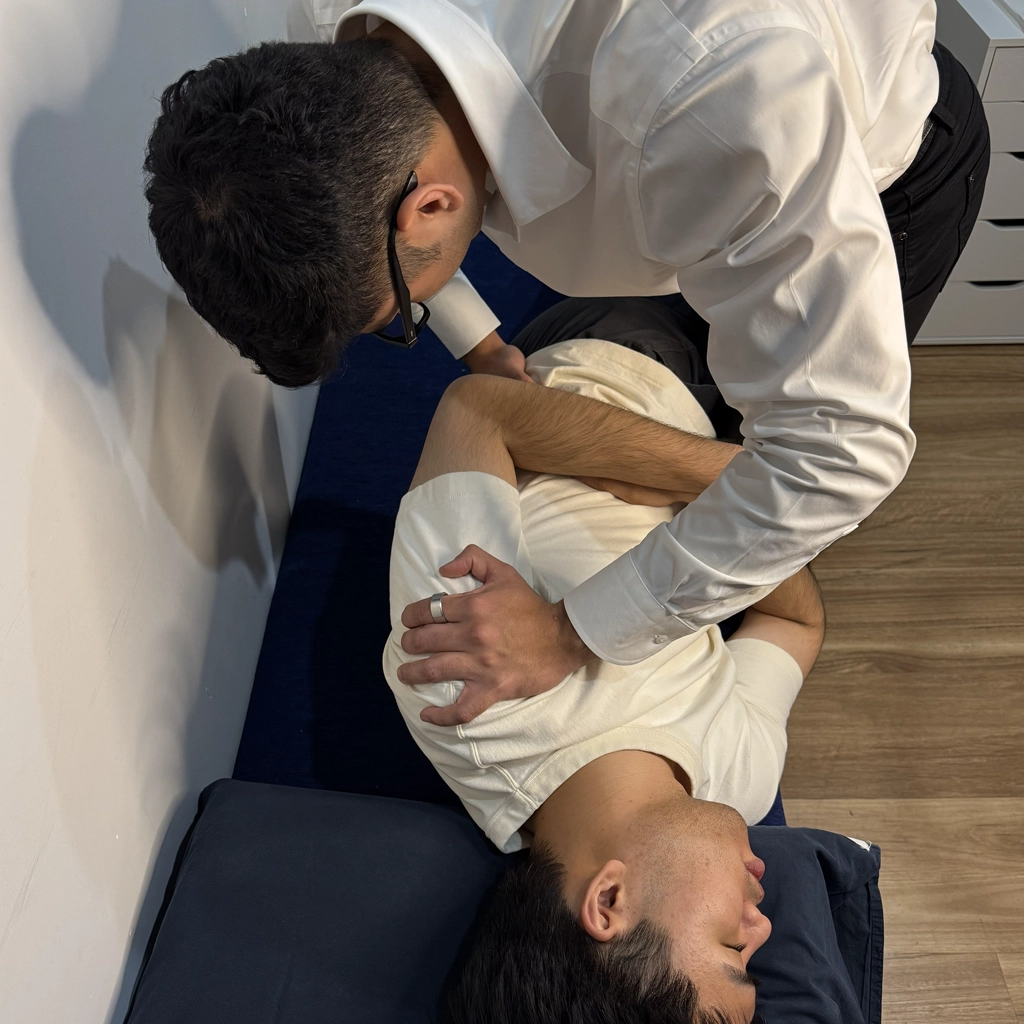
Gonstead adjustments utilize a specific-contact, short-lever-arm approach with minimal rotation to restore appropriate movement to restricted SI and spinal segments. This precision is vital for conditions involving joint dysfunction.
- Biomechanical Goal: For hypomobile (fixated) SI joints, specific manual adjustments, such as those performed on the pelvis, are used to help restore the joint’s normal mobility and alignment. This aims to reduce aberrant strain on the surrounding ligaments and improve the pelvis’s ability to transfer load efficiently.
- Neurophysiological Effect: By precisely stimulating mechanoreceptors, the adjustment may help modulate pain signals at the spinal cord level (pain gating) and enhance central nervous system processing. Research suggests that spinal manipulation improves muscle function either through facilitation or disinhibition of neural pathways, which is crucial for improving the function of core stabilising muscles associated with SIJD.
- Specialised Tables: Adjustments are performed using specialized equipment, such as the Hydraulic Hi-Lo Table or the knee-chest table, which allows the practitioner to position the patient correctly for a precise, targeted, and safe adjustment, accommodating patients with severe pain or limited mobility.
By combining precision manual therapy with active rehabilitation advice on stabilisation exercises, Gonstead chiropractic care aims to address the mechanical source of the pain, thereby supporting long-term stability and functional recovery from SI joint dysfunction.
8. Your Next Steps
Dealing with persistent low back or deep buttock pain can be frustrating, especially when daily activities are affected. The first crucial step towards finding relief is obtaining an accurate assessment to determine whether the pain is indeed originating from the SI joint, the lumbar spine, or another structure.
A professional assessment using the precision of the Gonstead system will determine the specific biomechanical factors contributing to your SI joint discomfort and establish a safe and effective plan tailored to your needs. The goal is to move beyond temporary pain management toward long-term functional recovery.
If you’re in Ringwood or nearby suburbs, our experienced Gonstead chiropractors can help you find relief and restore movement. Book your consultation with Ringwood Chiropractic today.
9. References
- AHPRA. (n.d.). Check your advertising: Chiropractic examples. Retrieved from (https://www.ahpra.gov.au/Resources/Advertising-hub/Resources-for-advertisers/Chiropractic-examples.aspx).
- Australian Commission on Safety and Quality in Health Care (ACSQHC). (2022). Low Back Pain Clinical Care Standard. Retrieved from https://www.safetyandquality.gov.au/standards/clinical-care-standards/low-back-pain-clinical-care-standard.
- Australian Institute of Health and Welfare (AIHW). (2022). Back problems. Retrieved from https://www.aihw.gov.au/reports/chronic-musculoskeletal-conditions/back-problems.
- Gonstead. (n.d.). Overviews of Gonstead Technique. Retrieved from https://gonstead.com/overviews-of-gonstead-technique/.
- Laslett, M., & Williams, M. (1994). The reliability of selected pain provocation tests for sacro-iliac joint pathology. Spine, 19(11), 1243–1249. Retrieved from (https://pubmed.ncbi.nlm.nih.gov/8059292/).
- Mayo Clinic. (2023). Sacroiliitis. Retrieved from https://www.mayoclinic.org/diseases-conditions/sacroiliitis/symptoms-causes/syc-20350747.
- National Institute for Health and Care Excellence (NICE). (2020). Low back pain and sciatica in over 16s: assessment and management. NICE Guideline NG59.
- Nejati, P., Safarcherati, A., & Karimi, F. (2019). Effectiveness of Exercise Therapy and Manipulation on Sacroiliac Joint Dysfunction: A Randomized Controlled Trial. Pain Physician, 22(1), 53-61. Retrieved from (https://pubmed.ncbi.nlm.nih.gov/30700068/).
- Robinson, D. A. (2023). Sciatica. In StatPearls. StatPearls Publishing. Retrieved from (https://www.ncbi.nlm.nih.gov/books/NBK507908/).
- Royal Australian College of General Practitioners (RACGP). (2022). Imaging in adults with acute low back pain. First Do No Harm. Retrieved from https://www.racgp.org.au/clinical-resources/clinical-guidelines/key-racgp-guidelines/view-all-racgp-guidelines/first-do-no-harm/gp-resources/imaging-in-adults-with-acute-low-back-pain.